
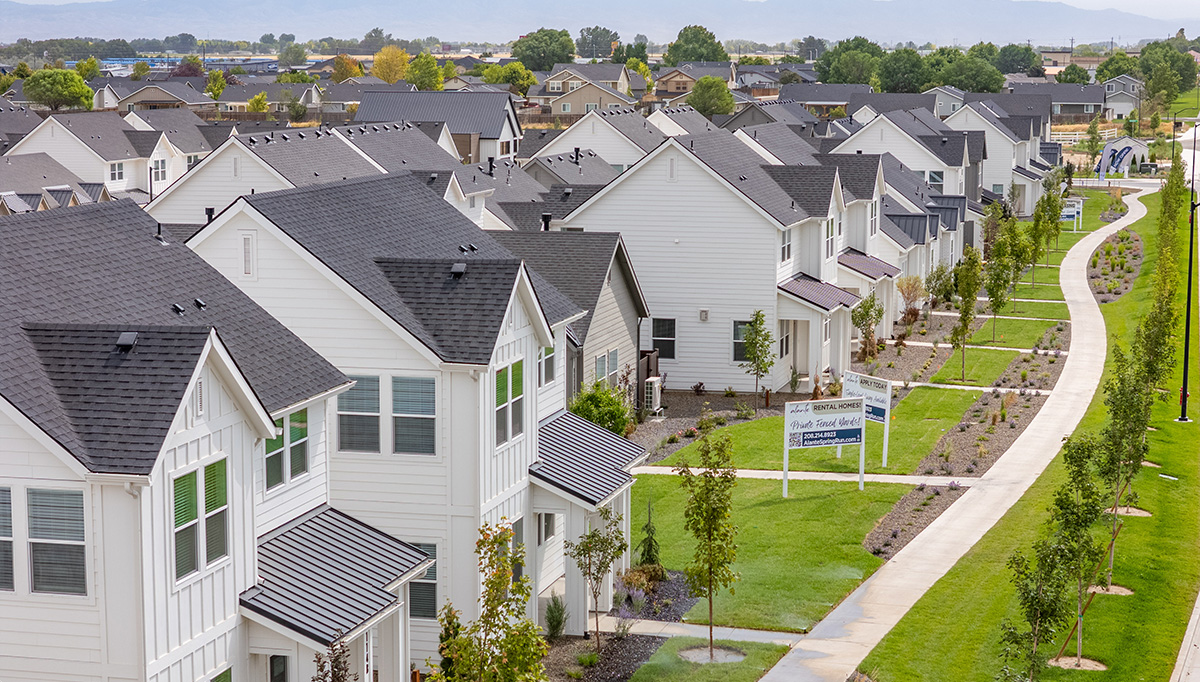
“Layton Construction came to the rescue in a big way—a way that saved us,” said PEG Companies Director of Development Tyler Phelps.
PEG, a full-service commercial real estate investment firm, first worked with Layton on a garden-style apartment project at Desert Color in Southern Utah. “We were having a tremendous experience with Layton, and knew we wanted to work with them again,” Phelps said.
The opportunity came sooner than expected, and under pressure. PEG was finalizing a contract on another project with a residential builder, and the deal fell through. “They couldn’t do the project under a guaranteed maximum price,” said Phelps. “We were scrambling, and that’s when Layton stepped up.”
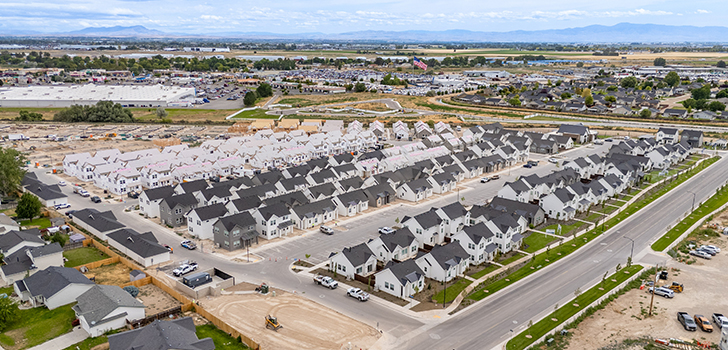
Alante Homes at Spring Run in Caldwell, ID
The project was Alante Homes at Spring Run in Caldwell, Idaho—a 233-home build-to-rent community and the largest of its kind in the state.
Welcome to a New Type of Neighborhood
Build-to-rent (BTR) is one of the fastest growing sectors in construction, comprising entire neighborhoods of single-family homes built specifically for renters.
“Entire neighborhoods are being built for BTR,” said Layton Director of BTR Larry Johnson, “These projects allow people who’ve been living in apartments—who want to start a family or just need more space—the opportunity to get into a home environment.”
Originally targeted at seniors in sunbelt states like Arizona or Texas, BTR has expanded dramatically, with projects scaling from small pilot communities to today’s massive 300-unit developments. In 2024, the BTR market hit an all-time high with 39,000 houses completed, representing a 15.5% increase from 2023. Today there’s over 350,000 BTR units in the market, with an additional 78,000 expected to be completed by 2027.
“The overall picture for BTR is extremely positive,” said Johnson, who spent decades in the residential sector before joining Layton.
“A traditional home builder isn’t aligned with the needs of a built-to-rent community”
Traditional homebuilding is expensive and can be inefficient. Residential builders who can easily scale are still selling to individual owners who make selections on finishes and other customizations. This creates variability with materials and timelines while creating different punch lists for every home. BTR consolidates all of that under one owner.
“When you’re selling properties to individuals, each house has different options. If you’re building a 500-unit community, that’s 500 custom houses,” described Johnson.
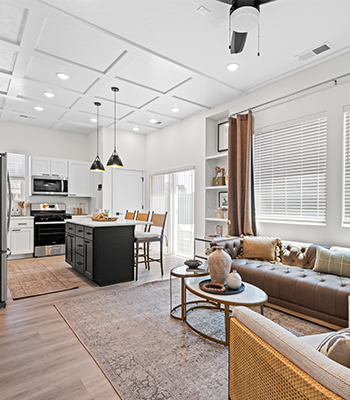
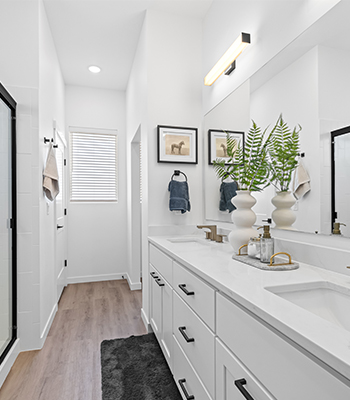
Interior unity at Alante Homes at Spring Run in Caldwell, ID
“In BTR, the developer typically chooses five to seven different floor plans. As a general contractor, with the right team, you can get into a momentum that allows higher performance,” added Johnson.
“That flow really helps drive the schedule, which allows us to provide the client with predictable outcomes, predictable sequencing, and predictable workload for the trade partners,” said Layton Project Manager Cooper Sharpe, who oversaw the Alante Homes build.
“The skill set of a traditional home builder isn’t aligned with the needs of a built-to-rent community,” explained Phelps, “And that’s where Layton’s commercial and multifamily experience comes in.”
The Power of Preconstruction
That experience includes deep preconstruction capabilities. Layton’s teams are accustomed to spending months—sometimes years—on complex projects before breaking ground, bringing alternative solutions to the table to get the project just right.
“We bring the same level of sophistication, planning, and execution that we use in our healthcare and industrial projects to the BTR space,” said Sharpe. “That’s what sets us apart.”
When Layton stepped in on Alante, the team identified opportunities early. “They really helped us navigate design issues that arose. With their advice, we swapped from a slab-on-grade foundation to crawl space foundation and saved us quite a bit of money,” explained Phelps.
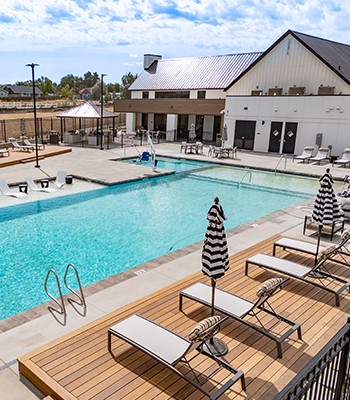
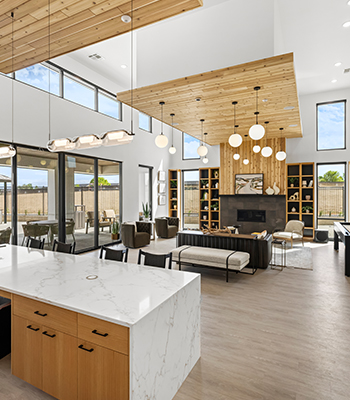
Clubhouse at Alante Homes at Spring Run in Caldwell, ID
Alante’s clubhouse was 6,000 square feet, and the property included a dog park, fire pits, and resort-style pool.
“A lot of these luxury BTR projects have amenities, like massive clubhouse facilities. Those are more sophisticated than a lot of the single-family contractors are capable of,” added Phelps.
“We’ve never seen anything like this before”
That’s what Sharpe’s team hears repeatedly from BTR clients.
“Municipalities love it,” said Sharpe. “They’re used to residential builders. When we show up with 4D schedules and BIM coordination, it changes the conversation.”
“Unlike a lot of our competitors, we use our visualization team to do 4D schedules. This shows the sequencing of how we’re going to build through the site and when we’re going to bring in different scopes and trade partners,” said Sharpe.
Underground utilities are among the biggest challenges in large-scale BTR developments. “You need to fit them in confined spaces between buildings,” Sharpe said. “When we bring in the sophistication of BIM and augmented reality, we can identify issues long before they happen, which is revolutionary in this growing market.”
46 Million Households and Counting
With 46 million American households renting and BTR completions up 15.5% year over year, the sector shows no signs of slowing. For developers like PEG, that means finding builders who can deliver at scale. For Layton, it means more opportunity to bring commercial-grade execution to a market that needs it.
“As housing markets continue to evolve, BTR neighborhoods are becoming a more common feature of the American suburban landscape,” said Johnson.
That holds true in Nashville, where Layton is currently delivering a mixed-use BTR community that combines townhomes, mid-rise residential, and podium construction. And the work keeps coming. Layton currently has five other BTR projects in progress across the country.
“These are the kind of projects that demand versatility,” Johnson said. “And that’s exactly where Layton’s commercial expertise pays off.”
Have questions about Layton? Or have a project coming up? Check out our portfolio and or contact us to discuss.
About Layton Construction
Layton Construction is a privately held national general contractor, delivering predictable outcomes in commercial construction since 1953. Headquartered in Salt Lake City, Utah, Layton operates from 16 strategic offices across the United States, employing more than 1,700 construction professionals who serve diverse markets including healthcare, education, commercial office, industrial, hospitality, and multi-unit residential. Founded on the core values of honesty, unity, safety, and quality, Layton has built a reputation for excellence in complex project delivery while maintaining strong partnerships with clients, architects, and trade partners nationwide.
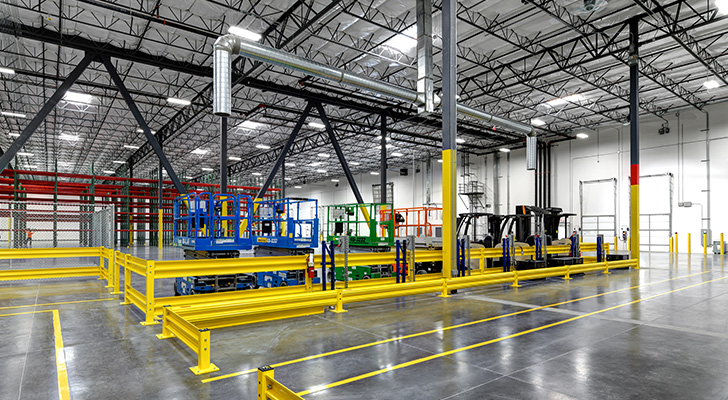
Considering the complexities of cold storage facilities, their construction demands a specialized approach and expertise. And with such a rapidly growing market, key players like Layton are primed and poised to step up.

Layton depends heavily on the expertise and capabilities of our trade partners. Led by Cherelle Cortez, our Trade Partner Engagement and Development team is focused on increasing economic impact and the growth of our trade partners.