
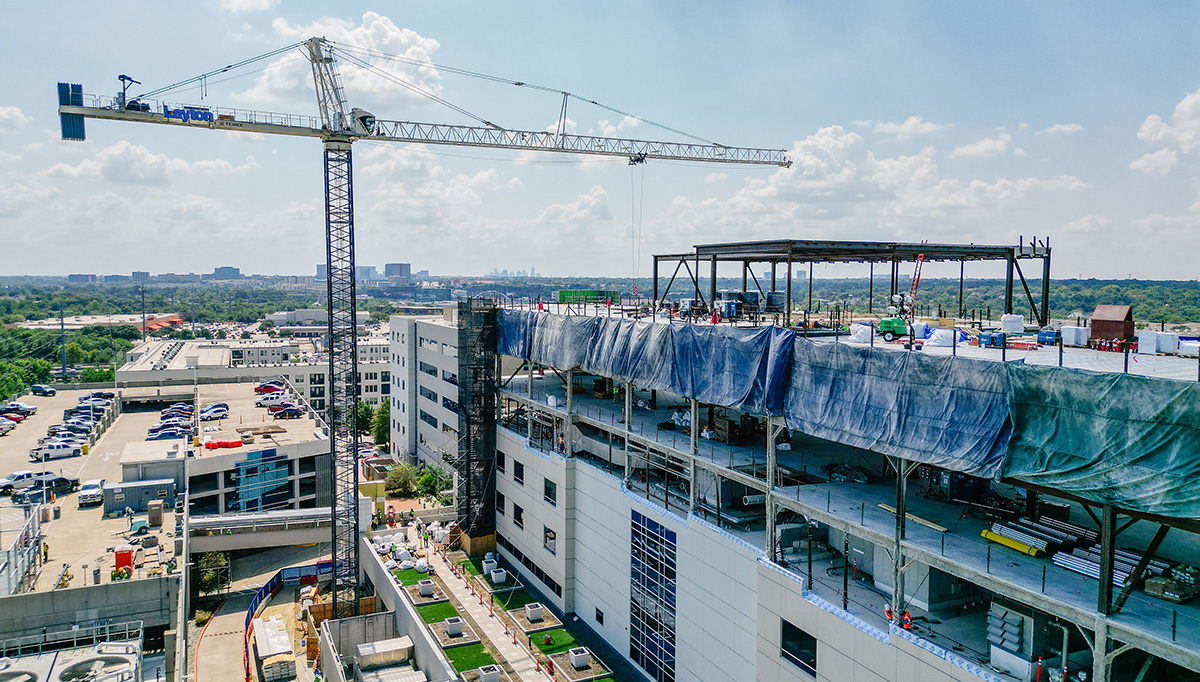
“I could see the jobsite from the window of our maternity room,” Layton Project Manager Mitchell Koch explained with a chuckle. “My wife told me, ‘Stop staring out the window. They’re okay.'”
Koch’s wife went into labor with their first daughter at Fort Walton-Destin Hospital in Fort Walton, Florida, the same hospital where Layton was two stories into a vertical expansion, and where she worked as an ER nurse.
“It’s crazy how personal these projects can become,” Koch said.
Hospital vertical expansion often happens directly above and around patients who can’t be moved, in buildings that can’t shut down for any period of time. There’s almost no margin for error. It was no wonder Koch felt the need to peak out the window.
Fort Walton was Koch’s first vertical expansion with Layton, completed in 2023. It was originally intended to be a four-story ICU tower addition, built for future vertical expansion, but when Layton reached 70% completion, HCA Florida gave the go-ahead to add two more floors.
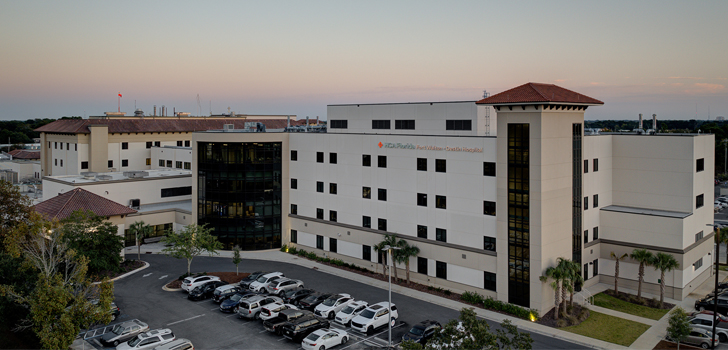
Fort Walton-Destin Hospital where Layton Construction added two floors to an existing facility.
“It was full circle,” said Koch. “We helped with the design, we built it with future vertical in mind, and before the job was complete, we were the ones chosen to add the additional floors.”
Koch would go on to manage vertical expansions at West Marion Community Hospital in Ocala and Lawnwood Hospital in Fort Pierce, both HCA Florida projects.
Connecting the Old with the New
“In the simplest explanation, vertical expansions are like assembling the greatest Lego set ever, but with incredibly high stakes,” explained Koch.
This construction type requires demolishing existing building envelope elements before crews can build up, all while maintaining the security of what’s left of that envelope. Very few contractors are willing to take on these kinds of projects, and the pool gets even smaller once you add a hospital’s infection control standards and the requirement to keep patients safe in an operating facility.
“Early involvement with these projects is a non-negotiable,” said Koch. “The logistical planning alone is substantial, so right off the bat we start meeting with the architects and design consultants to talk through the plan, and we ask the questions we know to ask based on our experience.”
Taking on the ‘Hard Stuff’
“Vertical expansions are difficult work, but the hard stuff is what we like, and our experience sets Layton up for success as we take on these challenges,” said Layton Senior Superintendent John Lopez.
Layton has been building vertical expansions since 2000, with nearly 40 vertical expansions in its portfolio.
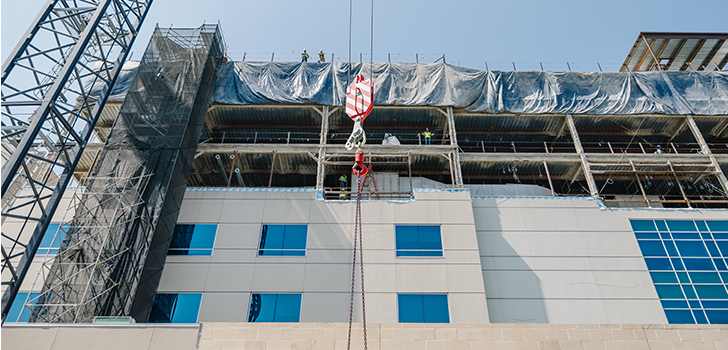
Medical City Dallas Heart & Spine Hospital where Layton added three floors to the existing facility.
“At the end of the day, every one of these jobs is different,” said Koch. “You can do 15 verticals and they’re all going to have very similar elements, but they’re all going to have their own unique thing that you didn’t run into on the last one.”
Reading the Bones of a Building
Unlike Fort Walton-Destin Hospital, when Layton starts a vertical expansion, the team isn’t always the general contractor who built the original building, which can lead to unforeseen complications.
“When we pull open the roof, we begin with a survey, long before we start placing steel,” explained Lopez.
During preliminary inspection at one of Lopez’s first vertical expansions with Layton, the team discovered the roof leaning two inches off from the base.
“How it got out of plumb in 16 feet, I don’t know,” Lopez said, “but it was our job to have those important conversations with the owner and implement a solution to correct the issue and maintain the integrity of the expansion.”
The early survey gave the team room to correct the lean before the added floors went up.
“Working on an addition to a building from 2022 is very different from adding to a building originally built in 1958,” Koch said. “We’ve worked on both sides of the spectrum, so we know how to get ahead of the problems, and that’s getting teams to the table as early as possible.”
Matching Old Systems to New
Blending the bones of a building is only part of the job. Teams also have to connect utilities and systems that may be decades apart in design standards.
“Energy code has changed across the country, so if you’re getting into an older building, the steel might be there, but that’s not the only thing we’re thinking about,” Lopez said. “How does the exterior skin now relate to the interior? Where is the insulation? The answers we get to those questions can significantly change the project profile.”
Working on older buildings adds another layer of difficulty: sourcing materials for a façade that blends seamlessly into the rest of the structure.
“This means getting your hands on the same type of brick, matching the glazing, and understanding the rate of weathering expected to match the wear and tear of the existing exterior,” said Lopez.
Protecting Patients on the Frontline
“I’ve never had a project that’s been emptied out for us when we started going vertical,” said Lopez. “You’re on an existing campus, space is finite, and you have people, often patients, down below you with live services underway.”
Vertical expansions are complicated under any circumstance, with work happening almost entirely above occupied space. At a hospital, that occupied space holds vulnerable patients and staff alike.
According to a recent CDC report, one in 31 hospital patients has at least one healthcare-associated infection, and in an environment where immune systems are already strained, every disruption matters. Construction stirs dust, disrupts airflow patterns, and can release contaminants if it isn’t properly managed.
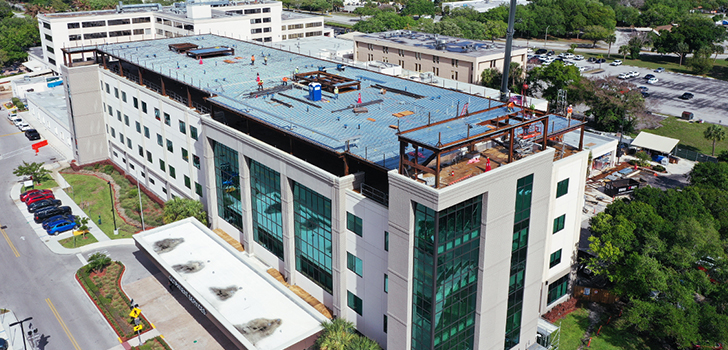
Lawnwood Hospital South Tower Expansion. Layton takes extreme safety measures when performing a vertical expansion to ensure no disruption to the patients receiving care below.
That’s where Infection Control Risk Assessment, or ICRA, comes in, a tool construction and healthcare teams use together to assess potential hazards and apply the right mitigation measures before work starts.
“We need to redirect the air intake to avoid sucking up dust and prevent it from getting dispersed through the hospital,” Lopez said. “This can protect patients as well as our own team members who are working in the area.”
Proven at West Marion
“We worked on West Marion for a little over two years, and we had zero interruption to patient care,” said Koch. “They never had to stop performing surgeries. That doesn’t happen every job.”
The West Marion Community Hospital expansion in Ocala included a two-story vertical expansion and two horizontal tie-ins, connected laterally to the operating room and the sterile processing department (SPD), spaces that handle some of the facility’s highest risk patients.
“We worked with the facility from the very beginning, regularly talking to hospital team members and C-suite executives, and giving the healthcare providers a direct contact on our team,” said Koch. “The hospital never had to halt any of their sterilizing and cleaning of equipment for surgeries while we were doing the SPD, and they never had to stop seeing patients on the rehab floor below while we were building on top of them. It speaks volumes to the planning and the execution of the plan for West Marion.”
Planning for Severe Weather
Vertical expansion means constantly sealing and resealing the roof once it’s open, so Layton keeps watch on both the build and the weather throughout. “We have emergency protocols set in place,” Lopez said. “If a cloud appears out of nowhere and looks like it might rain, the team can cover it all up at a moment’s notice.”
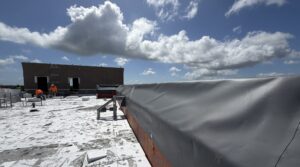
Waterproofing a roof mid-expansion means planning for the weather that hasn’t happened yet. This membrane and edge detail keep water out while the building underneath stays fully operational, rain or shine.
The stakes climb even higher during a storm, since a vertical expansion is at its most exposed with the roof open. “When you open the roof to place new columns, you can be pretty exposed,” Koch explained, “which is why Layton’s prep work to keep the facility dry and uninterrupted proves critical.”
Koch’s project at West Marion was threatened by not one but two major hurricanes during its construction: Milton and Helene. “We spent a lot of time prepping, all hands on deck, to keep the facility operating as it should,” said Koch.
Layton’s team not only prepared their work site but also helped hospital staff prepare the rest of the hospital campus. “During a storm, we’re constantly communicating with both our teams and hospital staff,” explained Koch.
Building for Longevity
That demand isn’t slowing down. Anticipating continued growth, more health systems are now building future vertical expansion into their hospitals from day one, which can reduce the exposure risk of a standard vertical expansion when the time actually comes to build.
This means bringing columns up past the roofline and capping them, so when it’s time to expand, a contractor can simply remove the caps and set new steel directly on top, eliminating the need for roof demolition.
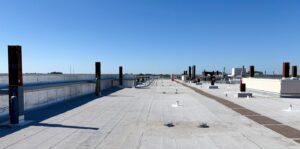
Layton installs extended column stubs so the future floor can go up without tearing into the roof first and exposing the hospital to the elements.
“Right now, we’re kind of in a vertical boom,” said Koch. “It’s like a cycle. My first three jobs were all greenfield hospitals and were planned for future vertical expansion. Now we’re building those very same anticipated additions.”
“Owners are really savvy with their facility development. They’re looking at the growth of the cities and markets and building with longevity in mind,” said Koch. “They might not need five more floors now, but they want to be ready for when they’ll need them in the next decade.”
Layton’s Palms West Hospital project in Loxahatchee, a ground-up facility that just celebrated its topping out, ran into the opposite scenario. Though they were planning for future expansion, the design didn’t call for column stubs. Layton flagged this immediately.
“We told the team, whether we are chosen to build this future addition or not, we need to do this,” Koch said. “It’s small dollars on the front end that will go a long way in the future. We’re looking out for the owner’s best interests.”
Growing Alongside Florida
Koch’s work at West Marion wrapped up in January 2026. He’s now set to complete his third vertical expansion at HCA Lawnwood in February 2027.
“It’s rewarding to see a shiny completed building, but it’s the impact we have on people’s lives that makes me excited to come to work every day,” said Koch, who started with Layton as a Florida intern in 2016 and has been with the company ever since.
Layton is expanding its own footprint in the state too, opening a new office in Tampa this fall and looking to grow alongside the hospitals it builds.
“The Layton culture is the reason why I’ve been with the company since I was 20 years old,” Koch said. “As we continue to grow, I’m excited to be a piece of that culture for somebody else.”
Have questions about Layton in Florida? Or have a vertical expansion coming up? Check out our portfolio and or contact us to discuss.
About Layton Construction
Layton Construction is a privately held national general contractor, delivering predictable outcomes in commercial construction since 1953. Headquartered in Salt Lake City, Utah, Layton operates from 16 strategic offices across the United States, employing more than 2,200 construction professionals who serve diverse markets including healthcare, education, commercial office, industrial, hospitality, and multi-unit residential. Founded on the core values of honesty, unity, safety, and quality, Layton has built a reputation for excellence in complex project delivery while maintaining strong partnerships with clients, architects, and trade partners nationwide.
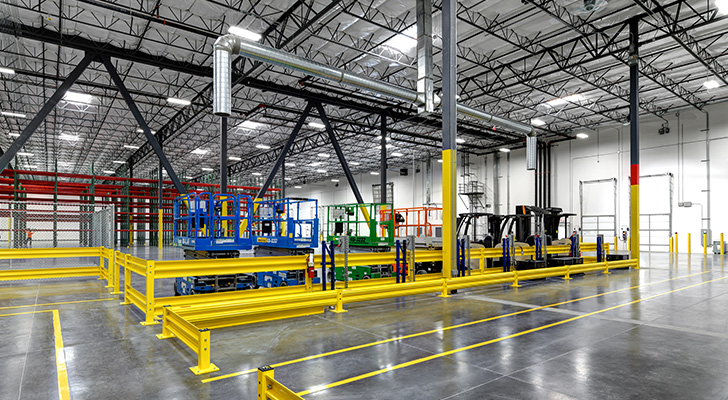
Considering the complexities of cold storage facilities, their construction demands a specialized approach and expertise. And with such a rapidly growing market, key players like Layton are primed and poised to step up.
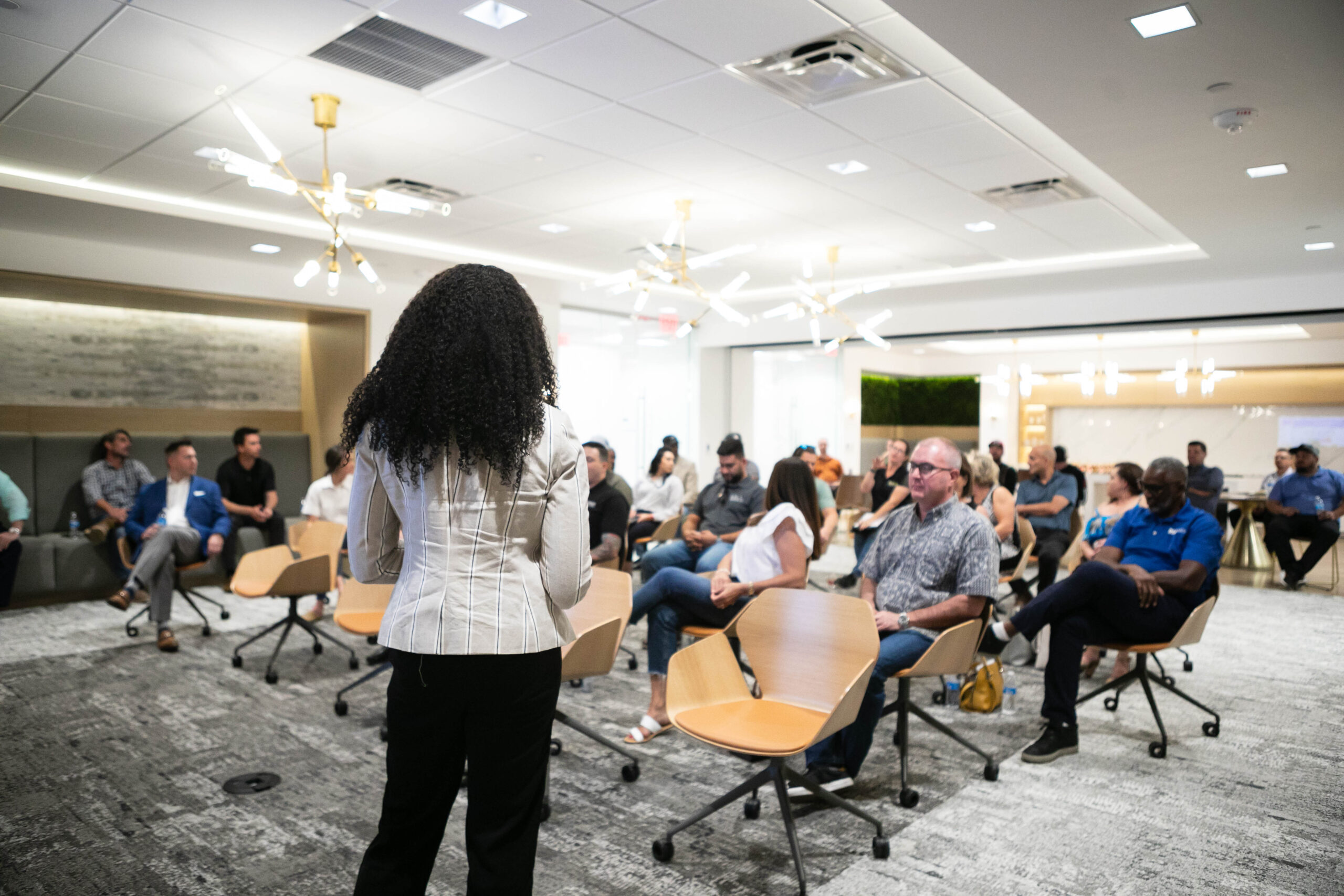
Layton depends heavily on the expertise and capabilities of our trade partners. Led by Cherelle Cortez, our Trade Partner Engagement and Development team is focused on increasing economic impact and the growth of our trade partners.