
It only took 20 seconds for the world to change.
The baseball diamond at Candlestick Park in San Francisco flooded with players and families alike as the 1989 World Series came to a halt and the world started shaking.
“It was an earthquake,” recalled Layton Preconstruction Manager Kimberly Allen.
It was a fall day in San Jose, where Allen was working at the time as an insurance agent. The office was empty except for her and one coworker, who stood frozen as the world quaked. “She was in shock. I picked her up, threw her over my shoulder, and got her outside.”
The Loma Prieta earthquake registered 6.9 on the Richter scale. More than 60 people lost their lives, and thousands were injured. The iconic Bay Bridge partially collapsed, and Game 3 of the World Series between the Oakland A’s and the San Francisco Giants was postponed for 10 days.
“Entire homes were falling off their foundations,” Allen said.
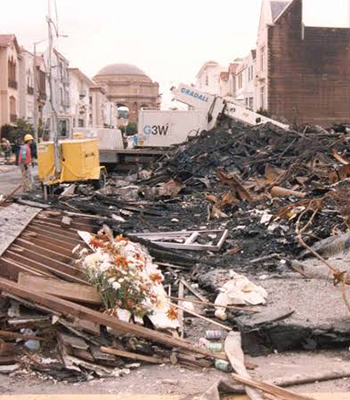
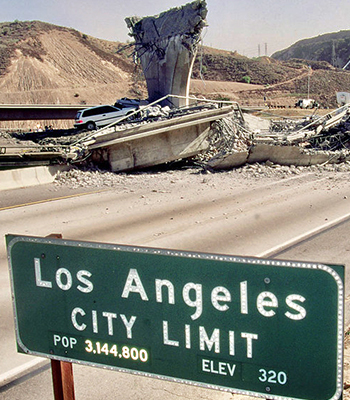
Damage caused during the Loma Prieta (left) and Northridge (right) earthquakes in California.
Just five years later, Southern California was rocked by the 6.7 Northridge earthquake. Fifty-seven people died and dozens of acute care hospitals in the region were evacuated. Six of those hospitals were evacuated within the first 24 hours.
The earthquake caused $20 billion in damage, making it the costliest earthquake in American history.
In the wake of these disasters, state lawmakers introduced Senate Bill 1953, or SB 1953, established seismic safety requirements for California’s general acute care hospital buildings, with a major 2030 milestone requiring them to remain operational after a seismic event.
When Expertise Meets Critical Need: Layton’s Role in California’s Seismic Challenge
Ranked among the nation’s top five healthcare contractors by Modern Healthcare, Layton has built a reputation working on complex projects for the country’s largest health systems. But nowhere is their expertise more critical than in California, where the state’s aging hospital infrastructure faces a ticking clock to meet seismic code.
Allen, who personally experienced the impacts of these disasters, is now part of the Layton team working to bring healthcare facilities up to code, save lives, and prepare for the next major quake.
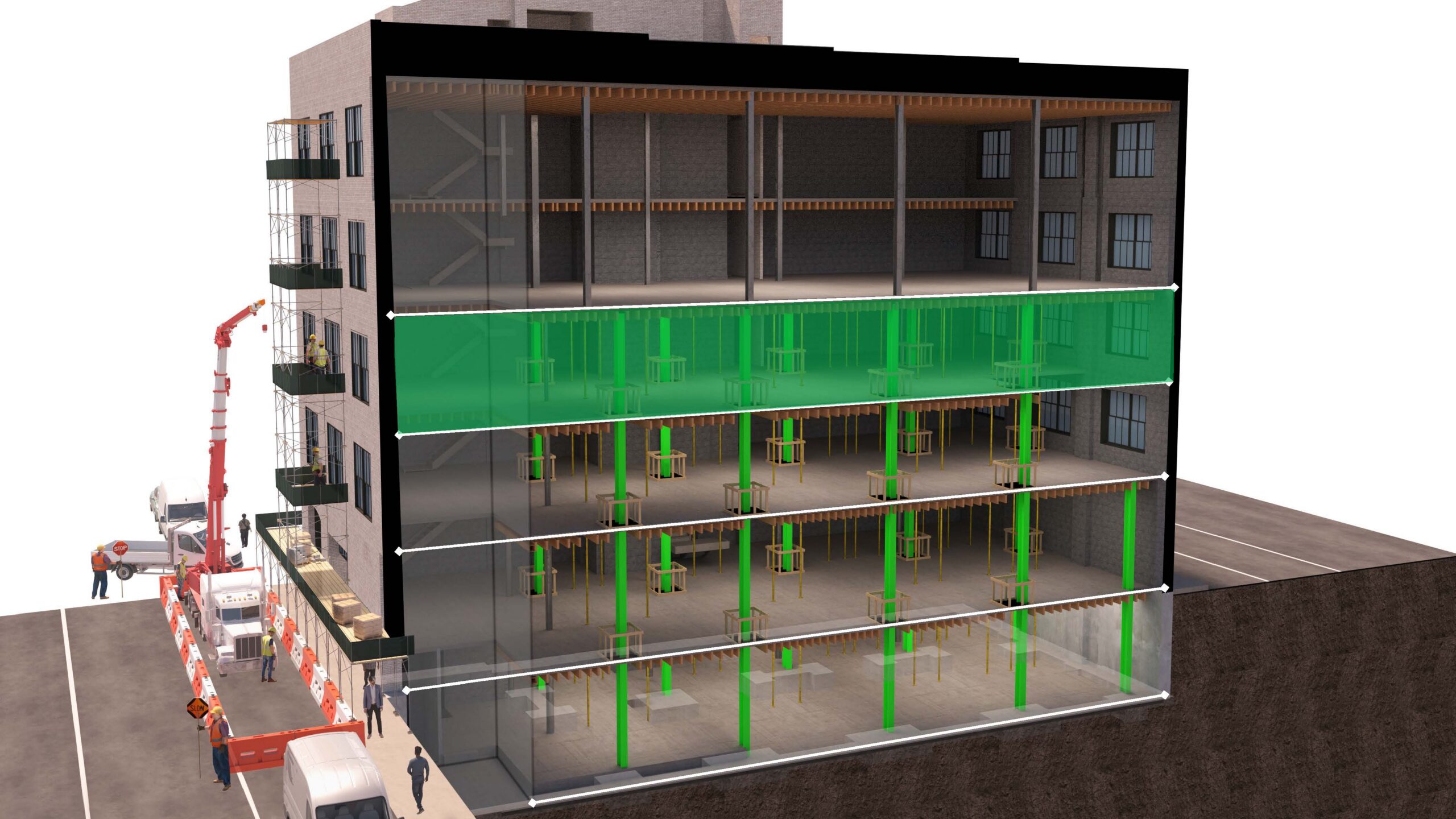
Foundation Strengthening Animation: Watch how Layton reinforces foundations to meet seismic code requirements. This animation shows the precision sequencing required to add micropiles, install shear walls, and strengthen structural systems all while the building stays standing.
A Market on the Brink: Billions in Work and 3.5 Years to Deliver
According to seismologists, the likelihood of a magnitude 8 or larger earthquake hitting California within the next 30 years has increased from 4.7% to 7%.
There’s no stopping the “Big One” from coming, but hospitals can prepare for it. And with the 2030 deadline approaching, California’s hospitals need partners who understand both seismic requirements and hospital operations.
The challenge is massive in scope. Of California’s roughly 400 acute care hospitals (facilities providing emergency care and intensive treatment), a significant percentage will require major retrofitting or reconstruction to meet the deadline. The total industry investment is projected to reach billions of dollars.
“The entire industry is impacted,” Allen said. “In three and a half years, all hospitals in California will be required not only to remain standing but also remain functional in the event of a major earthquake. If they don’t meet it, then they can’t operate.”
The Technical Gauntlet and Reading the Legislative Alphabet Soup
The seismic requirements fall into two categories: structural and non-structural. The structural work—reinforcing foundations, adding shear walls, ensuring buildings can move without collapse—is complex but relatively straightforward.
The non-structural work is where it gets truly challenging.
Hospitals don’t operate like most buildings. They can’t simply sway with an earthquake like a skyscraper. Every utility—electrical, plumbing, HVAC, fire suppression—must remain functional post-earthquake.
For the 2030 structural requirement, existing acute care buildings generally need to meet an accepted Structural Performance Category pathway, such as SPC-4D or SPC-5, depending on the building and compliance strategy.
“SPC-4D was created so existing hospitals could meet the 2030 requirements without a complete rebuild,” said Layton Manager Karina Russell.
“By meeting the compliance requirements of the 2030 deadline, it ensures these structures are robust enough to withstand the forces of an earthquake,” Russell said.
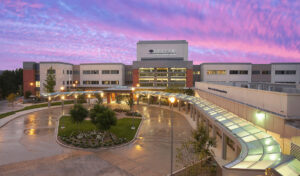
Los Robles Hospital & Medical Center in Thousand Oaks, California where Layton has been performing continuous seismic upgrades.
In addition to the structural requirements, there are Non-Structural Performance Categories, NPC 4 and NPC 5. These requirements can include bracing overhead utilities in congested ceiling spaces, protecting key building systems, and adding infrastructure that helps hospitals operate after a major earthquake, including water, wastewater, and fuel storage
“We need to ensure the overhead utilities in our interstitial spaces are braced in a manner that, in the event of an earthquake, they don’t break apart,” Russell said.
“NPC 5 requires these hospitals to be self-sustaining for 72 hours,” Russell said. “We’re having to add larger wastewater storage tanks, water storage tanks, and fuel storage tanks.”
“A lot of our facilities are landlocked,” Allen said. “These tanks can be 40,000 gallons each and sites have multiple tanks. Finding room for the tanks is typically taking over parking spaces, which are at a premium for most facilities.”
The hard part is doing this work inside operating hospitals. There is zero room for error.
Customized for Existing Conditions
While the standards might sound straightforward, each project has unique circumstances and needs.
“Every facility solves this differently,” said Kyle Nitchen, who is overseeing multiple seismic projects at Los Robles Regional Medical Center in Thousand Oaks. “At Los Robles, our path includes major foundation work and new structural shear walls inside an active hospital. We’re bringing two towers into compliance while the hospital keeps taking care of patients.”
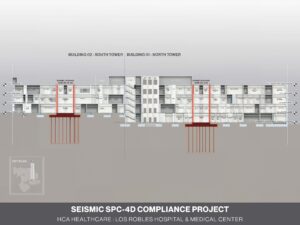
While a typical earthquake-safe building might move with the shaking, healthcare facilities operate differently. Teams need to limit movement as much as possible.
At Los Robles, Layton is adding more than 100 micropiles into the foundation and seven stories of shear walls to prevent the towers from swaying laterally.
“We had to break the work into 20+ phases in order to keep the hospital running,” Nitchen said. “That means we’re planning around patient care, staff access, infection control, noise, vibration, dust, and daily operations.”
“Before the loud work started, we studied the noise,” Nitchen said. “Demo, drilling, framing, MEP work, concrete pours. We wanted to know what patients and staff would actually hear before we started. Then we brought in an acoustical consultant to help us design the temporary walls, review Sound Transmission Class (STC) ratings, and place sound blankets where they would do the most good.”
“Some noise can be reduced. Some of it has to be managed,” Nitchen said. “So we worked with the care teams on the patient experience too: how to communicate before the loudest work starts, when to schedule it, and even whether tools like iPads or VR headsets could help patients through the worst stretches.”
The Physics of Safety and A Hospital Tower Floating up into the Sky
Meanwhile, Layton has an upcoming project in San Jose where the owner has chosen to build a new hospital in lieu of retrofitting their existing building. The project is going to utilize a base isolated system for the foundation.
“It’s a technique used to isolate ground movement from the building during an earthquake. The building sits on top of bearings that allow the entire building to move independently of the ground movement,” Russell explained.
“Base isolation is a technique used to isolate ground movement during an earthquake from the building. The building sits on top of bearings that allow the entire building to move independently of the ground movement. For this to work, the building has a moat of air built around it so the building doesn’t hit anything as it’s moving on the bearings during an earthquake. It’s exactly what you would think when picturing a moat around a castle.”
Base isolation has been slow to grow in the United States but is now catching on, with countries like Japan, China, New Zealand, Chile, Peru, Colombia, and Ecuador leading the way. As of 2015 Japan, known for its seismic activity, had over 4,100 base isolated structures.
At Sharp Grossmont Hospital for Neuroscience in La Mesa, Layton tackled a unique challenge: connecting an existing wood-frame building to a new steel structure and ensuring the new hybrid structure and connection was up to code.
It’s the kind of innovative problem-solving that comes from truly understanding hospital operations. Layton’s teams understand hospital workflows, infection control, patient safety, and operational continuity. No matter the building type, all require planning work in phases that don’t disrupt patient care, coordinating with medical staff, managing complex scheduling across multiple departments.
It’s why major health systems trust Layton with these critical projects.
The Race Against Time
Nitchen, Russell, and Allen are managing multiple seismic retrofit projects across California right now. So are dozens of other Layton teams. With the 2030 deadline three and a half years away, the work is urgent and complex.
For most contractors, retrofitting active hospitals to meet seismic code would be overwhelming. For Layton, it’s standard, and the kind of work that comes from years of managing healthcare facilities under pressure.
“We work inside active hospitals every day,” Nitchen said. “That matters on seismic work because the construction plan has to respect the care plan. You have to understand access, shutdowns, infection control, patient movement, staff workflows, and how one missed detail can ripple through the hospital.”
That expertise translates directly to seismic work. When hospitals need to remain fully operational during construction, when every decision impacts patient care and safety protocols, when timelines can’t slip—that’s when healthcare construction experience becomes essential.
Have questions about Layton? Or have a project coming up? Check out our portfolio and or contact us to discuss.
About Layton Construction
Layton Construction is a privately held national general contractor, delivering predictable outcomes in commercial construction since 1953. Headquartered in Salt Lake City, Utah, Layton operates from 16 strategic offices across the United States, employing more than 1,700 construction professionals who serve diverse markets including healthcare, education, commercial office, industrial, hospitality, and multi-unit residential. Founded on the core values of honesty, unity, safety, and quality, Layton has built a reputation for excellence in complex project delivery while maintaining strong partnerships with clients, architects, and trade partners nationwide.
Considering the complexities of cold storage facilities, their construction demands a specialized approach and expertise. And with such a rapidly growing market, key players like Layton are primed and poised to step up.
Layton depends heavily on the expertise and capabilities of our trade partners. Led by Cherelle Cortez, our Trade Partner Engagement and Development team is focused on increasing economic impact and the growth of our trade partners.