
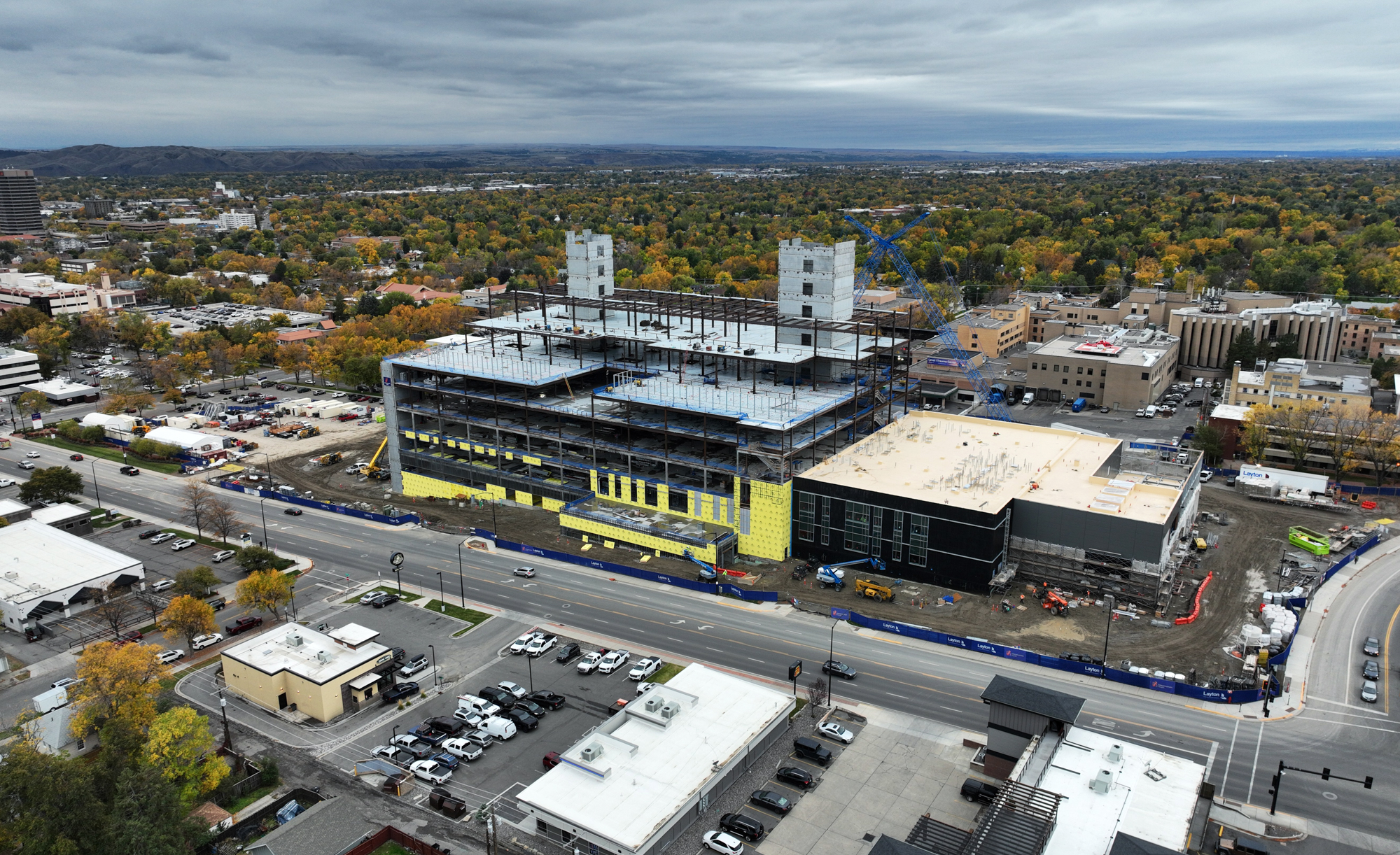
“I have binoculars on the roof for kids to watch the big crane,” said Melissa Gjerde, the general manager of 406 Kitchen & Taproom in Billings, Montana.
Beneath Billings’ iconic sandstone rim, the new St. Vincent Regional Hospital is rising, with a massive blue crane towering above it all.
“I think it’s going to be great for the Billings community. Now we can compete with bigger cities like Denver,” added Gjerde.
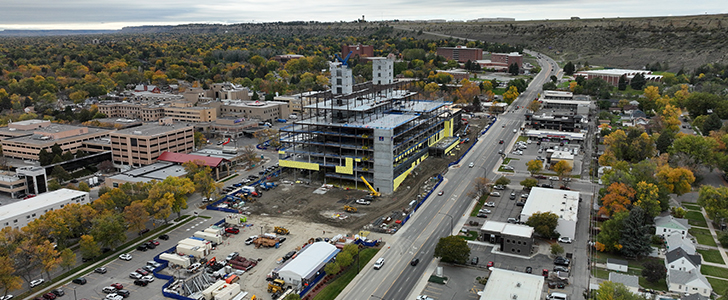
In the last six years, the population of Billings has grown by 5,000 people, a rate of 0.14% annually. This rise in population is creating a massive need to reinforce the healthcare industry.
A recent University of Montana report found that healthcare is among Montana’s top five fastest-growing industries, adding more than 5,200 jobs over the past five years. More people mean a need for more space, creating the demand for the replacement hospital.
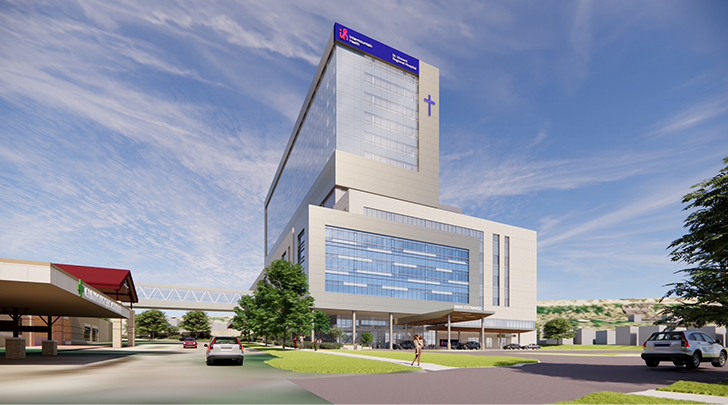
Once completed in spring of 2029, the replacement St. Vincent hospital will be a 737,000-square-foot, 14-story Level I trauma center. It will serve patients across Montana, Wyoming, North Dakota, and South Dakota.
Knowing the demands of the region and being involved early in the design process through an Integrated Project Delivery (IPD) approach, Layton was able to suggest alternative design strategies that were atypical for the St. Vincent team.
“Layton really understood what we needed to make this the most efficient, highest quality and safest facility we could build,” said Lee Boyles, President of St. Vincent Regional Hospital.
Walking through the original hospital is like walking through time, with hallways and building additions spanning decades and even centuries. Initial approaches to the new replacement hospital mirrored that familiar sprawled approach, until the project team made building up an option.
“It’s the creativity and the ingenuity of Layton and the project team that give us the option to go vertical,” said Boyles. The new design kept patients and caregivers top of mind, with the goal of minimizing confusion, preventing excess steps or walking, and providing the new space needed for the growing community within the limited property lines.
“We at Intermountain felt that Layton was not only the right contractor for the project but also a great partner because of their ability to collaborate with those in the community,” said Boyles.
Building Big and Boosting Business
Having more than 500 construction workers move in next door isn’t always good news for a business. At 406, though, visitors are greeted by a big sign that reads “Construction Workers Welcome.”
“I even made a few extras I keep in the back,” said Gjerde, adding she’s seen a boost in business since construction began, “The Layton construction workers are the best.”
In some spots, the jobsite sits less than 20 feet from the fence line, roughly the size of a pickup truck. To put that in perspective, a standard tower crane base typically measures about 15 to 30 square feet. Combine that tight space with the fact that the property is in downtown Billings along one of the busiest roads in town, and the Layton team’s successful collaboration really begins to shine.
“We’ve got residents on one side, a college on another, a working hospital with one of the busiest helipads in the region right next door, and an international airport right above us,” explained Layton Senior Superintendent Brandon Bergener. “Layton teams have to coordinate with all those different folks constantly.”
Bergener has been with Layton for over 25 years and calls Billings home, so the project’s neighbors are also his neighbors.
“We’re inserting ourselves into other people’s lives,” he said, “It’s understanding that disruption, anticipating any additional disruptions, and using that knowledge and experience to minimize and prevent our impact.”
Planning Beyond the Property Lines
As construction manager (CM), Layton oversees the whole site experience on behalf of St. Vincent. Two of the biggest concerns from the start were parking and dust control.
With more than 500 workers on site at peak, the team got ahead of parking before it became a problem. “We rented a parking garage in downtown Billings and we’re running shuttles for workers,” said Layton Senior Project Manager Luke Halpin. “It is a significant undertaking.”
There was no hesitation when implementing a plan like shuttles to keep impact on neighbors to a minimum. It’s the reputation of the client that’s on the line, and Layton takes that responsibility seriously.
“Layton has the experience in this. They’ve had the experience of building healthcare institutions, hospitals, especially of this scale,” said Boyles.
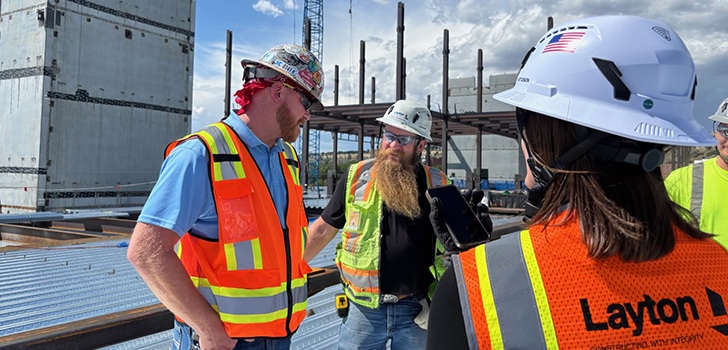
The next big challenge was the need to keep even the air surrounding the site clean and clear. “There’s multiple reasons we want to keep the air clean,” said Halpin, “first being that we’re right next to an existing hospital. We want to ensure patients coming and going, as well as visiting family and friends aren’t worried about dust and dirt getting kicked up.”
The project team always keeps a truck with water available to hose down the surrounding area whenever they think there’s a chance things might get dusty.
“Second, we don’t want our dust to cause an accident on the road,” said Halpin.
Layton’s prioritization of keeping the site clean is getting noticed by everyone in town.
“I park several blocks away from the hospital, and I don’t see litter. Layton has kept the site clean, and they’ve been great neighbors,” said Boyles.
Increased safety is a natural byproduct of maintaining such a clean site, but Layton doesn’t stop there. The team at St. Vincent also conducts weekly safety lunches and daily safety walks, employs mass text alerts for emergency scenarios, and sends StruxHub alerts for any mass jobsite impacts.
Leaning Local, a Coordination Solution
“A big challenge when we brought in Layton was not only the scale of the project but that they also needed to work on said project within an incredibly tight construction envelope,” described Boyles.
Working in such a confined space becomes incredibly challenging as teams pour concrete on the decks, “It’ll be over 200 yards a day for a week straight, which will mean coordinating 20 trucks a day,” explained Layton Superintendent Tracy Robinson.
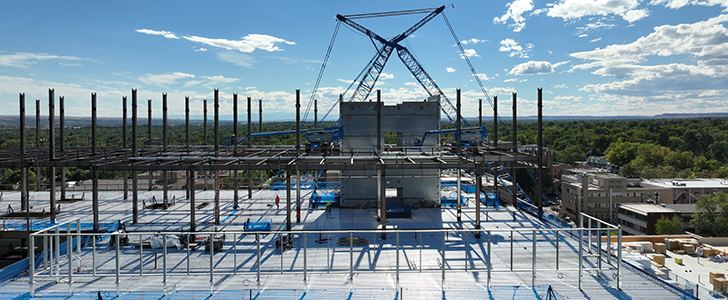
But the solution to the massive coordination and product delivery in a tight space also means looking for materials closer to home.
“Relying on local businesses has actually made coordination easier,” said Luke Foster with LPR Construction.
Being a good neighbor also means “trying to keep as much of the money that is coming through this project local,” explained Bergener.
“Layton has done a very, very nice job of leveraging the skill and expertise within the community of Billings and eastern Montana and, honestly, all of Montana,” said Boyles, “We have people from all over the state working on this project, and that Montana pride has been incredible.”
For Layton, buying local is only the beginning. It’s also about giving back.
Work Doesn’t End When Construction Does
“We’re involved in local fundraisers and community events. As a father of six kids who live here, I’m a part of the community. We’re all part of the community. That’s just how we operate,” said Bergener.
That commitment to do more than build a hospital is what sets Layton apart.
“Layton’s been a really good partner, not just to us as the owners of this building,” said Boyles, “but to the neighborhood, to the university, to the city of Billings.”
Not to mention, they’re even supporting businesses across the street. “Crews even lent me some cones so I could help a neighbor ahead of the Blue Angles Airshow,” explained Gjerde.
“We’re a city, but we’re a big town. I think people really like to help each other,” added Gjerde, “It’s very much still that borrowing a cup of sugar kind of stuff and then you return the favor.”
Between the bones of the rising new hospital, the old hospital which first opened in 1899 can still be seen, sprawling across time and space. It’s served the area for over a century, and this new hospital will do the same.
“The hospital will continue to serve generation after generation after generation,” said Bergener. “St. Vincent has continued to grow and evolve and serve the community, and this is a continuation of that legacy.
Have questions about Layton? Or have a project coming up? Check out our portfolio and or contact us to discuss.
About Layton Construction
Layton Construction is a privately held national general contractor, delivering predictable outcomes in commercial construction since 1953. Headquartered in Salt Lake City, Utah, Layton operates from 16 strategic offices across the United States, employing more than 2,200 construction professionals who serve diverse markets including healthcare, education, commercial office, industrial, hospitality, and multi-unit residential. Founded on the core values of honesty, unity, safety, and quality, Layton has built a reputation for excellence in complex project delivery while maintaining strong partnerships with clients, architects, and trade partners nationwide.
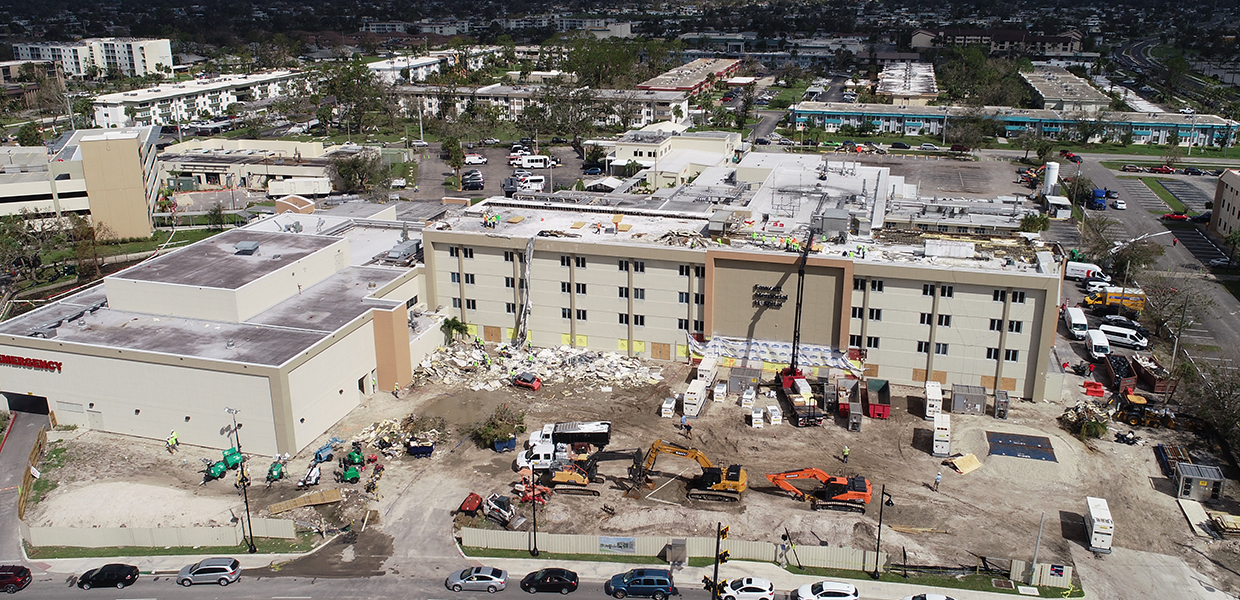
When a Category 4 hurricane flooded a 250,000-square-foot hospital, Layton's Florida team and dozens of trade partners worked through shortages, chaos, and the holidays to bring it back.
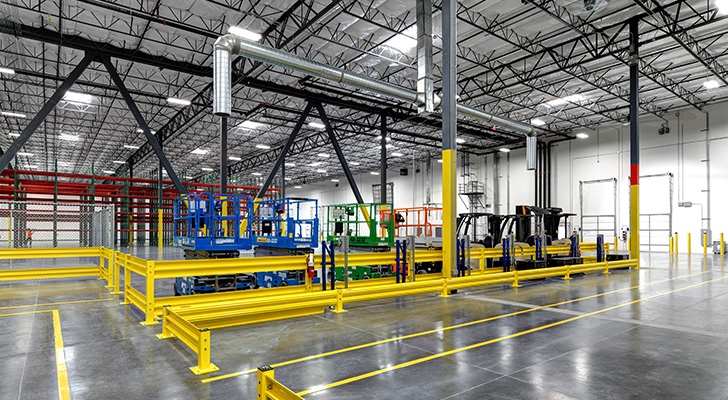
Considering the complexities of cold storage facilities, their construction demands a specialized approach and expertise. And with such a rapidly growing market, key players like Layton are primed and poised to step up.